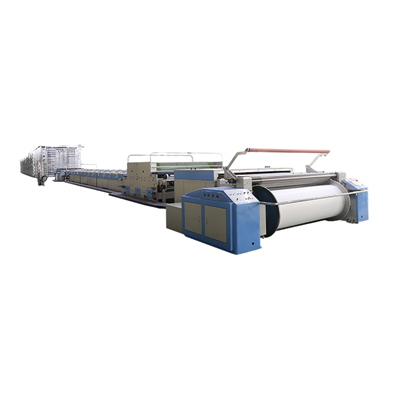
In the textile manufacturing process, the sizing machine plays a crucial role. As a well – established sizing machine supplier, I’ve spent a great deal of time exploring and understanding various aspects of these machines, including one of the most fundamental yet important elements: the alignment system. Sizing Machine
The Basics of the Alignment System
The alignment system of a sizing machine is a set of mechanisms and technologies designed to ensure that the warp yarns are properly positioned, parallel, and evenly spaced throughout the entire sizing process. When warp yarns are fed into the sizing machine, they need to be precisely aligned to achieve the desired sizing quality. A misaligned set of warp yarns can lead to uneven sizing, which in turn affects the subsequent weaving process and the final quality of the textile fabric.
The alignment system starts with the creel section. The creel is where the warp beaming packages are placed. In a typical sizing machine setup, there could be dozens or even hundreds of warp yarns coming from the creel. The alignment here is crucial because any tightness or looseness in the yarns at this stage can be magnified as the yarns travel through the machine. One of the common methods used for initial alignment at the creel is the use of tensioners. These tensioners can be mechanical or electronic. Mechanical tensioners work based on the friction principle, where the yarn passes through a series of discs or guides that can be adjusted to apply the right amount of tension. Electronic tensioners, on the other hand, use sensors to measure the tension of the yarn and make automatic adjustments. This helps in keeping all the warp yarns at a consistent tension, which is essential for proper alignment.
The Role of Guides and Splitters
As the warp yarns leave the creel, they move towards the sizing trough. Along the way, there are a series of guides and splitters that play a vital role in the alignment system. Guides are used to ensure that the yarns follow a specific path. They can be made of various materials, such as ceramic or stainless steel. Ceramic guides are popular because they have a low friction coefficient, which reduces the wear and tear on the yarns. The shape and design of the guides are carefully engineered to prevent the yarns from tangling or deviating from their intended path.
Splitters, as the name suggests, are used to separate groups of warp yarns. In a large – scale sizing operation, the warp yarns are often divided into smaller sections for better management and alignment. Splitters can be fixed or adjustable. Adjustable splitters are more flexible as they can be re – configured according to the specific requirements of different textile products. For example, if a fabric requires a different number of warp yarns per unit width, the adjustable splitters can be adjusted to create the appropriate spacing between the yarn sections.
Alignment in the Sizing Trough
Once the warp yarns enter the sizing trough, the alignment system needs to ensure that they are evenly immersed in the sizing solution. Uneven immersion can lead to inconsistent sizing of the yarns. To achieve this, there are usually a series of rollers inside the sizing trough. These rollers are designed to guide the warp yarns through the sizing solution at a constant speed and in a parallel manner.
The pressure rollers in the sizing trough also contribute to the alignment. They apply a certain amount of pressure on the warp yarns, squeezing out the excess sizing solution. At the same time, they help to maintain the alignment of the yarns. If the pressure is not evenly distributed, the yarns may shift or bunch up, resulting in uneven sizing. Therefore, the design and adjustment of the pressure rollers are critical for the alignment system in the sizing trough.
Post – Sizing Alignment
After the warp yarns exit the sizing trough, they go through a drying process. During this stage, the alignment system continues to work. The drying cylinders or hot air chambers are designed in such a way that the warp yarns are evenly exposed to the heat source. If the yarns are not properly aligned during drying, they may shrink or stretch unevenly, which can affect their dimensional stability.
There are also additional guides and tensioning devices after the drying section to further correct and maintain the alignment of the warp yarns. These guides help to smooth out any minor irregularities in the yarn path and ensure that the yarns are ready for the subsequent processes, such as beaming.
The Impact of a Well – Functioning Alignment System
A well – functioning alignment system in a sizing machine has several significant benefits for textile manufacturers. Firstly, it improves the quality of the sized warp yarns. Evenly sized yarns have better strength, abrasion resistance, and smoothness. This directly translates into a higher – quality fabric during the weaving process. Fabrics made from well – sized and well – aligned warp yarns have fewer defects, such as broken yarns and uneven dyeing.
Secondly, it enhances the efficiency of the entire textile production process. When the warp yarns are properly aligned, there are fewer machine stoppages due to yarn breakages or tangles. This reduces downtime and increases the overall productivity of the sizing machine and the subsequent weaving machines.
Finally, it allows for greater flexibility in textile production. A precise alignment system enables manufacturers to produce a wider range of fabric types and patterns. Different fabric designs may require different densities and spacing of warp yarns. With a good alignment system, these variations can be easily achieved.
Challenges in the Alignment System
Despite its importance, the alignment system in a sizing machine also faces several challenges. One of the main challenges is the wear and tear of the alignment components. Over time, the guides, rollers, and tensioners can wear out, which affects their performance. Regular maintenance and replacement of these components are necessary to ensure the continued proper functioning of the alignment system.
Another challenge is the management of different types of warp yarns. Different yarns have different physical properties, such as diameter, elasticity, and surface friction. These differences can make it difficult to maintain a consistent alignment for all types of yarns. Manufacturers need to adjust the alignment system parameters according to the specific characteristics of the yarns being processed.
Future Developments in the Alignment System
The future of the alignment system in sizing machines looks promising. With the development of advanced sensor technologies and automation, we can expect more intelligent alignment systems. Sensors can be used to continuously monitor the alignment and tension of the warp yarns in real – time. Based on the data collected by these sensors, the alignment system can make automatic adjustments to ensure optimal performance.
In addition, the use of artificial intelligence and machine learning algorithms can further improve the alignment system. These technologies can analyze large amounts of production data to predict potential alignment problems and make proactive adjustments. This will not only improve the quality and efficiency of textile production but also reduce the reliance on manual intervention.

As a sizing machine supplier, we are committed to staying at the forefront of these technological developments. We offer a range of sizing machines with state – of – the – art alignment systems. Our machines are designed to meet the diverse needs of the textile industry, from small – scale workshops to large – scale industrial production.
Beaming Machine If you are in the textile manufacturing business and are looking for a reliable sizing machine with an advanced alignment system, we invite you to contact us for a detailed discussion. Our experienced team of professionals can provide you with customized solutions based on your specific requirements. We look forward to partnering with you to improve the quality and efficiency of your textile production.
References
- Smith, J. (2018). Textile Manufacturing Technology. Oxford: Oxford University Press.
- Davis, R. (2019). Sizing Machine Operations: A Comprehensive Guide. New York: Harper & Row.
- Johnson, M. (2020). Advances in Textile Machinery Alignment Systems. Journal of Textile Engineering, 45(2), 78 – 89.
Jiangsu Huanqiu Jingtian Machinery Co., Ltd.
As one of the most professional sizing machine manufacturers and suppliers in China, we are able to meet the needs of the majority of our customers. Please feel free to buy high quality sizing machine made in China here from our factory. Contact us for more details.
Address: No.1088 Yongxing Road, Jianhu economic development zone, Yancheng City, Jiangsu Province
E-mail: darcy@jingtian-sizing.com
WebSite: https://www.cnhqjtjx.com/
