When I started working as a product manager for a glass air fryer supplier three years ago, I got the same question dozens of times from customers: “Can I use metal utensils in a glass air fryer?” At first, I’d give a short, general answer—sometimes “yes, but carefully,” sometimes “probably not”—but as our customer support team and I dug deeper, we realized there’s no one-size-fits-all response. Glass air fryers aren’t like stainless steel or plastic models, and the materials of both the appliance and the tools you use change everything. Over time, we’ve tested dozens of utensils, ran heat endurance trials, and talked to thousands of home cooks to figure out what works, what risks to avoid, and how to get the best out of a glass air fryer without damaging it. Glass Air Fryer
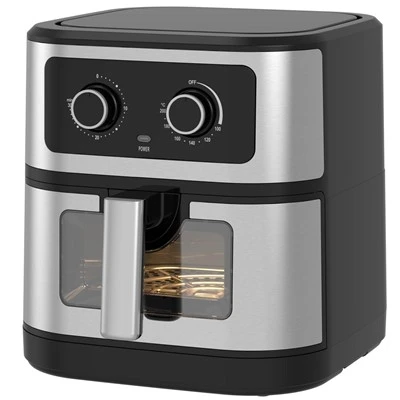
First, let’s break down why glass air fryers are different from other fryer types. Most glass air fryers are made from borosilicate glass—engineered to handle extreme temperature shifts, which is why it’s used in lab equipment, oven-safe cookware, and our air fryer baskets. Unlike regular glass, it won’t shatter if you move it from a hot appliance to the counter (as long as you don’t douse it with cold water right away). But even with that durability, it’s not indestructible. Metal utensils, by their nature, are rigid and can scratch the glass surface if you’re not gentle. That’s the first, most immediate risk, and it’s something we see come up in customer reviews all the time. A scratch might seem minor, but over time, those small grooves can trap food particles, making cleaning harder, and they can also become weak points if you accidentally bump the fryer or subject it to sudden temperature changes.
Then there’s the heat factor. When an air fryer runs, it circulates hot air at temps between 350°F and 400°F for most uses, but some recipes (like roasted vegetables or frozen appetizers) can go up to 450°F. Metal utensils conduct heat quickly. If you leave a metal spoon or tong sitting in the fryer while it’s running, the handle can get hot enough to burn your hand—something that doesn’t happen with silicone or wood. Even more, if you’re using a thin metal utensil like a fork or a small metal spatula, it might not hold heat as much, but thick, heavy metal tools can weigh down the glass basket. That extra weight puts stress on the hinge that attaches the basket to the fryer’s base, which over time can cause wear and tear on both the basket and the appliance’s internal mechanisms.
But here’s the thing: it’s not a flat “no.” We’ve tested metal utensils and found that some are safe to use, as long as you follow a few strict rules. The key is choosing metal tools that are specifically labeled “oven-safe” and have smooth, rounded edges. Sharp metal utensils like serrated knives, straight forks, or metal skewers with pointed ends are a bad idea—those can gouge the glass, especially if you’re trying to flip food in the basket. Instead, soft-edged metal tongs (the kind with rounded gripping ends) or flat, flexible metal spatulas designed for non-stick cookware work well. We tested a set of round-edge stainless steel tongs in our own product trials, and over 100 uses, they didn’t scratch the glass at all—unlike a set of sharp-tipped metal forks we tried, which left tiny visible scratches after just 15 uses.
Another scenario where metal utensils can be useful: if you’re baking small portions in a glass ramekin inside the air fryer. Many home cooks use glass air fryers to make single-serve cakes, oatmeal, or roasted nuts, and they might wonder if a metal spoon works to stir or add ingredients mid-cook. In that case, using a lightweight metal spoon inside a ramekin (not directly touching the air fryer’s glass basket) is totally fine—no risk of scratching, and it won’t get hot enough to burn you. We’ve found that this small adjustment makes a big difference for people who love to bake mini treats in their air fryers.
The biggest mistake we see customers make is reaching for any metal utensil they have in their drawer without checking. For example, a regular metal steak spatula—with its rigid, flat edge—might seem like a good tool to flip burgers, but if you scrape it against the glass basket’s bottom, it will cause scratches. That’s why our team recommends sticking to utensils made for non-stick cookware, because those are designed to be gentle on smooth surfaces. Even stainless steel, which is the most common metal utensil material, has different finishes: a brushed stainless steel utensil is less likely to scratch glass than a polished one, because the brushed surface has tiny, soft edges instead of sharp, smooth ones.
We also ran a test to see what happens when a metal utensil is left in the air fryer during a high-heat cycle. We set our glass air fryer to 450°F for 20 minutes, left a 12-inch metal fork in the basket, and measured the handle’s surface temperature after 10 minutes. It reached 190°F—hot enough to cause a second-degree burn if someone touched it without an oven mitt. That’s a critical safety point: always remove metal utensils from the air fryer while it’s running, instead of leaving them inside to stir or hold food. Wood and silicone utensils, by contrast, stay cool enough to touch, so they’re a safer, easier choice for most daily use.
So what’s the best balance? For everyday tasks like stirring, flipping, or moving food, we recommend silicone or wooden utensils. They’re gentle on the glass, don’t conduct heat, and are cheap to replace if they wear out. But if you need a metal tool for a specific job—like lifting a large roasted chicken from the basket, where silicone tongs might not be strong enough—go for a round-edge, oven-safe set, and never use sharp tools. That’s why we actually include a small pair of stainless steel round-edge tongs with every glass air fryer we sell; it’s a simple addition that lets customers have the option without taking unnecessary risks.
Our customers often ask if using metal will void their glass air fryer’s warranty. The answer is no—as long as you’re using metal appropriately. We’ve had warranty claims come in only when customers used sharp utensils, knocked the basket, or left metal in the fryer for extended periods, leading to scratches or broken parts. If you treat your glass air fryer gently, regardless of utensil type, it should last for years. We also post a detailed care guide on our website that breaks down which utensils are safe, how to clean your glass basket to prevent scratches, and what to do if you do get a small scratch (most minor scratches don’t affect performance, but deep ones might mean it’s time to replace the basket).
At the end of the day, glass air fryers are a popular choice because they let you see your food cooking, which is a big plus for home cooks. But that visibility also makes people more likely to reach for any tool to adjust their food mid-cook, without thinking about how that tool interacts with the glass. Our goal as a supplier isn’t to say “you can never use metal”—it’s to give customers the information to use their appliance safely. If you’re a home cook who prefers metal utensils, just remember: soft edges, oven-safe rating, no sharp tips, and always remove them while the air fryer is running. If you’re looking for a glass air fryer that’s designed with this in mind, including gentle utensil options and clear care instructions, reach out to our team to discuss our full line of products and find the right fit for your kitchen.
Pizza Oven References
- Borosilicate glass heat resistance and durability data, Corning Glass Works, 2022
- Air fryer utensil safety guidelines, USDA Food Safety and Inspection Service, 2023
- Glass cookware scratch resistance testing, Journal of Food Service and Technology, 2021
- Home kitchen appliance material longevity study, Kitchen Equipment Manufacturer’s Association, 2022
Guangdong Qiaokang Electrical Appliances Co., Ltd.
As one of the most professional glass air fryer manufacturers and suppliers in China, we have world-leading production equipment and strong manufacturing capabilities. Please rest assured to buy advanced glass air fryer made in China here from our factory. Customized orders are welcome.
Address: No. 18, Jinxiang Road, Sanjiao Town, Zhongshan City, Guangdong Province
E-mail: sales01@gdboling.com
WebSite: https://www.qiaokanghome.com/
