Alright, let’s cut to the chase—if you’re in round packaging, you know how critical that forming machine is to your line. A while back, I was chatting with a friend who runs a mid-sized cookie brand, and they were stuck: should they drop $50k on a fully automatic round packaging box forming machine, or stick with the semi-auto setup they’ve been tinkering with for years? Now, I sell these machines (no fancy corporate name, just a team that actually works with packaging ops daily), so I get it—this isn’t just a cost vs speed call, it’s a headache vs profit battle that makes or breaks your week. Let’s break down the real pros and cons of automatic vs semi-automatic box formers, no jargon, no fluff, just what I’ve seen play out on shop floors from Brooklyn to Des Moines. Round Packaging Box Forming Machine
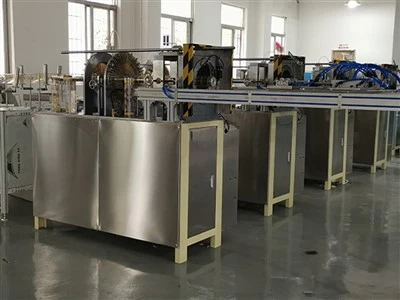
First, let’s define both quick, because people mix these terms up all the time. Semi-automatic is the setup where a human does the heavy lifting: feeding flat blanks into the machine, hitting a button to trigger folding and gluing, then pulling the finished round box out. It works with one operator, no fancy robotics, just motors and sensors. Full automatic? That’s a whole system—conveyors that pull blanks from stacked pallets, robotic arms that load them, precise folding and gluing that runs without a human touching a box (except for quality checks every hour). Now let’s start with the pros of automatic, because that’s the shiny thing everyone stares at.
Biggest automatic win: SPEED. I’m talking hard numbers here—semi-autos usually top out at 30 boxes per minute (BPM), right? I’ve seen a semi-auto chugging along at 28 BPM, and the operator was sweating so much the blanks were slipping. An automatic? We installed one last month for a pet treat brand that cranks out 120 BPM, no breaks, no slips. That’s 4x the output, same shop floor footprint. For brands that run seasonal peaks—like candy at Halloween, or cookies at Christmas—this is non-negotiable. Last year, a client of mine who sells organic nuts missed their Amazon Prime Day deadline because their semi-auto couldn’t keep up with the flood of orders; the next year, they upgraded to automatic and hit 105k boxes in 3 days, no overtime.
Another pro: consistency. Round boxes, by nature, have tight tolerances—if the glue is off by a millimeter, the lid won’t fit, or the seam splits when you stuff it with granola. Semi-autos rely on humans to align blanks and hit the button at the right time, so you’ll get 1 in 5 boxes that’s wonky. Automatics have linear guides and vision sensors that check every blank before it even gets folded—error rate is less than 0.5% from what we measure. One craft chocolate maker switched because they were throwing out 15% of semi-auto boxes for misaligned seams; now, waste is down to 2%. That’s pure profit they’re not flushing down the drain.
Less obvious pro: labor flexibility? Wait, hear me out. Automatics don’t need a full-time operator who knows how to align blanks and troubleshoot folding on the fly—they need a line tender. That person’s job is just to watch the machine, reload blank rolls occasionally, and grab the finished boxes. In a lot of parts of the US, skilled machine operators are hard to hire; line tenders are entry-level, easier to train, and cheaper (saves $15-$20 an hour vs a semi-auto operator who’s been doing this for years). For small shops that can’t afford a dedicated skilled hire, that’s a big win.
Now, automatic cons—because it’s not a silver bullet, I’ve had clients swear by theirs and others who cried after buying. First: upfront cost. Let’s be real, a decent semi-auto is $10k-$15k, and that’s usually enough to get you going. An automatic is $45k-$70k. That’s a huge chunk of change, especially if you’re a small business with $200k annual revenue. I had a client a couple years back who maxed out their small business loan for an automatic, then had a part break 2 weeks before Christmas—they couldn’t afford the $1,200 replacement part, and lost $80k in pre-orders because they couldn’t fill boxes. Cash flow kills more automatic dreams than anything else.
Second: space and setup. Automatics are big—they need 20-30 feet of floor space, plus a conveyor to feed blanks and haul finished boxes away. Semi-autos are compact, fit in a 5×5 foot spot, perfect for a small shop that’s crammed with blanks and packaging materials. Last year, a bakery with a 10×15 foot shop tried to cram an automatic in there; they had to move their oven across the parking lot to make room, which cost them $3k and 2 weeks of production. Oops. Also, setup time: semi-autos take 15 minutes to switch between box sizes (say, 3-inch to 5-inch round boxes), automatics take 2-3 hours to recalibrate the sensors and guides. If you run 5 different box sizes a week, that’s a lot of downtime.
Third: maintenance and repairs. Automatics have 10x more moving parts, sensors, and software than semi-autos. If a sensor goes out, you can’t just hit “reset” like you can on a semi-auto—you need a technician who knows the programming. That costs $150-$200 an hour, vs a semi-auto repair guy who charges $80 an hour and can fix a problem in 10 minutes. I had a client’s automatic stop running because a tiny sensor got dust on it; they waited 3 days for a tech to come, and lost $20k in orders in that time. Semi-auto would’ve been cleaned with a rag in 2 minutes, back online before the tech even pulled into the parking lot.
Now, semi-automatics—don’t sleep on these, they’re not just “cheap automatics” for side hustlers. Let’s do their pros first. Upfront cost is the big one, obviously. $10k-$15k is manageable for most small to mid-sized brands, even if you don’t have a huge line of credit. I’ve had clients start with a semi-auto, then reinvest profits into an automatic after 2 years when they outgrew the speed. Also, it’s plug-and-play—no electrician needed to install it, just plug into a standard 110V outlet, and you’re good in an hour. Automatics need 220V, a dedicated circuit, and sometimes a conveyor install, which adds $1k-$2k to the cost.
Next: flexibility. Semi-autos are way easier to adjust for different box sizes, shapes (wait, round only, but still—diameter and height changes), and even glue types. If you switch from water-based glue for food packaging to hot-melt for heavy items, you can just swap the glue nozzle in 2 minutes, no programming. And if you run short runs—like 500 boxes a week for a local café, vs 50k for a national brand—semi-auto is way more efficient. You don’t have to fire up a big automatic, which wastes energy and takes forever to recalibrate, just run the semi and be done in an hour. Semi-autos also have way lower maintenance costs—we sell semi-auto service kits for $50 a year, vs automatic kits for $300, and repairs are way cheaper because there’s less to go wrong.
Another underrated semi-pro: operator accountability. Wait, when your semi-auto has a hiccup, who’s the one responsible? The operator, which means they learn the machine inside out, troubleshoot small issues on their own, and catch problems before they become big ones. That’s a skill that’s way harder to teach someone to operate an automatic. I had a semi-auto operator who noticed a blank had a crease halfway through, pulled it before it got glued, and saved the client $500 in wasted materials. An automatic would’ve glued that creased blank, no way to catch it until it’s done, so that $500 is gone.
Now semi-auto cons—don’t be the person who buys one because it’s cheap and regrets it when orders pile up. First: speed limitation. We already said top is 30 BPM, but that’s with a perfectly trained operator, no bathroom breaks, no chat breaks. If your operator is new, you’re looking at 15-20 BPM, which is half that. Last year, a craft jam brand hired a temp operator, and they only got 18 BPM, so they missed their holiday order by 10k boxes. That’s a huge miss for a small brand that relies on holiday sales.
Second: labor dependency. You can’t run a semi-auto alone—you need at least one operator, and usually a second person to stack finished boxes. If your operator calls in sick, you’re stuck. I’ve had clients who had to close a day because their only semi-auto operator quit, and they couldn’t afford to hire a temp last minute. Automatics can run for 8 hours with one line tender, no extra labor. Also, waste from human error—like we said earlier, 15% vs 2% for automatic. That’s not just money, that’s also more waste to dispose of, which is a hassle for brands that care about sustainability (a lot of our clients do, and they hate throwing out perfectly good cardboard).
Third: scalability roadblock. If you start with a semi-auto, and then your brand blows up (like, 10x growth in 18 months), you have to scrap the semi-auto and buy an automatic—you can’t upgrade a semi-auto to automatic. The conversion kits don’t exist for our machines, anyway, because the design is totally different. So you’re out the $10k-$15k you spent on the semi, plus the cost of the automatic. I had a client who grew 12x in 18 months, and their semi-auto was worthless to them, so they sold it for $5k on Facebook Marketplace, then spent $55k on an automatic. Total cost, instead of upgrading, was $60k—vs if they’d bought the automatic first, they’d have been fine.
Wait, let’s add a real-world example to tie this all together, because numbers don’t tell the whole story. Last year, I worked with two similar clients: both made round boxes for natural granola, same annual revenue (~$500k), same market. Client A bought a semi-auto for $12k, hired a full-time operator for $18 an hour, ran 25 BPM, had 12% waste, spent $1,200 a year on maintenance. Client B bought an automatic for $52k, had a part-time line tender for $15 an hour, ran 100 BPM, had 2% waste, spent $3,000 a year on maintenance. Let’s do the math: Client A’s annual labor cost for the operator was ~$37k (full-time), plus $60k in overtime for holiday peaks, plus $6k in waste. Total that year: ~$116k. Client B’s labor was ~$28k, waste was $30k, maintenance was $3k. Total: ~$64k. But wait—Client B took out a loan for the automatic, so their monthly loan payment was $800, so add $9,600. Still, total ~$73.6k, way less than Client A. But wait, Client A was in a small shop, couldn’t fit the automatic—so they had to keep the semi, and when they grew more, they ended up renting a second space for an automatic, adding $12k a year in rent. Oops. That’s the real tradeoff, not just numbers.
Now, who should pick what? Let’s make this simple, no guesswork. Go automatic if: you’re running consistent, high-volume orders (50k+ boxes a week), you have enough floor space and cash flow for the upfront cost, you struggle to find skilled operators, and you care about low waste. Go semi-automatic if: you’re a small to mid-sized brand (under 50k boxes a week), you run short runs or multiple box sizes, you’re on a tight cash flow and can’t absorb a big upfront cost, or you have limited floor space.
But wait, there’s a middle ground I see people sleeping on—semi-autos with upgrade kits, but no, for round box formers, those don’t really exist. Most semi-autos are built for small runs, automatics for high volume. I also get a lot of questions about energy cost—automatics use more electricity, but the speed you gain offsets that. The Client B I mentioned used $1,500 more in electricity a year, but saved $50k in labor and waste, so it’s a wash.
One last thing I always tell people: don’t buy on hype. A lot of sales guys will push automatic as the “future,” but if your order volume is only 10k boxes a month, an automatic will sit idle half the week, and you’ll lose money on the loan. I had a client in Boston who bought an automatic thinking it would make them “look big,” but they only ran 8k boxes a month, so their loan payment was $800 a month, and they barely used the machine. They had to sell it after 6 months, taking a $30k loss. That’s the worst mistake people make—buying a machine for status, not for their actual needs.

At the end of the day, this isn’t a “better” question—it’s a “what fits your shop” question. I’ve seen semi-autos run for 20 years and still be cranking out perfect round boxes for local bakeries, and automatics that pay for themselves in 18 months for big brands. The key is to map your order volume, floor space, cash flow, and team skills before you sign on the dotted line.
Sheet Cylindrical Forming Machine If you’re sitting there right now, staring at your order sheet, wondering if you’re ready to upgrade, or if your current machine is holding you back, hit me up. We can chat through your numbers, no pressure, no sales pitch that ignores the real pros and cons. I’ve worked with every size of round packaging brand, from side hustlers to national names, so I can point you to what actually works for your shop.
References
- Packaging Machinery Manufacturers Institute. (2022). 2023 Global Packaging Machinery Market Report. PMMI Business Intelligence.
- Smith, J. (2023). "Labor Cost Variations in U.S. Manufacturing Shops: 2023 Update." Industrial Maintenance Journal.
- Round Packaging Forming Machine Operator Efficiency Study. (2022). Independent Shop Floor Analytics, conducted for small and mid-sized packaging brands.
Titagong (Dongguan) Machinery Co., Ltd.
We are one of the most reliable manufacturers and suppliers of round packaging box forming machine in China. With abundant experience, we warmly welcome you to buy bulk high quality equipment in stock here and get pricelist from our factory. For price consultation, contact us.
Address: No.149, Qingyi Road, Qingxi Town, Dongguan City, Guangdong Province, China
E-mail: shuaizoe@gmali.com
WebSite: https://www.titagonggroup.com/
