If you’ve ever worked in manufacturing, you’ve probably heard the buzz about 5 axis machining centers—but let’s cut through the jargon and talk specifically about the swivel head variety, since that’s what we supply day in and day out. A lot of people mix up swivel head 5 axis machines with other 5 axis setups, but trust me, there’s a big difference that changes how you work, especially for shops tackling complex parts. 5 Axis Machining Center
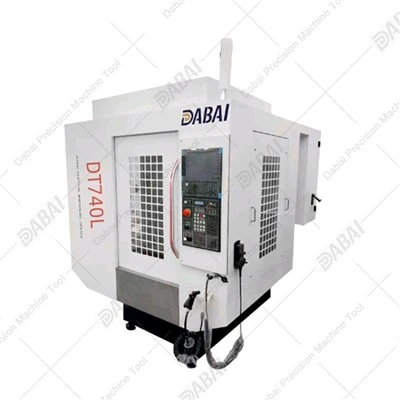
First, let’s ground this in basics. Traditional 3 axis mills only move along X, Y, Z: left/right, forward/back, up/down. They work fine for simple stuff—like a flat block with holes drilled straight through, or a basic mold half—but hit a wall when parts have angled surfaces, undercuts, or sides that aren’t facing straight at the tool. Enter 5 axis: two extra rotational axes let you tilt or spin the part or the tool to get to those tricky spots. Now, swivel head (also called head-swiveling) is when that rotation is on the machine’s spindle head, not the worktable.
Here’s what actually makes a swivel head 5 axis center different. On a table-swiveling 5 axis machine, the worktable tilts and spins, which means if your part is big or heavy, you’re lifting tons of pounds just to reorient it. Not to mention, if you have multiple parts loaded on the table, you can’t access every side without moving them. With swivel head, the spindle itself moves: it swivels around two axes (usually A and C, if we’re using standard CNC lingo) to angle the cutting tool directly at any surface of the part, no table movement needed. That keeps your workholding simpler too—no fancy, heavy fixtures to bolt onto a rotating table.
Let’s break down the axes a little more for anyone who’s not deep into CNC coding. A typical swivel head setup has: linear X, Y, Z axes for positioning, plus a swivel A axis (which tilts the spindle up and down, like a shoulder joint rotating forward/back) and a rotary C axis (which spins the spindle around its own axis, like your elbow spinning your wrist). Together, these let you point the tool at almost any angle, so you can machine a part from every side in one setup—no stopping to flip the part, no re-fixturing, no chances of misalignment from moving the work.
Why does that matter for real shops? Let’s take examples we see all the time: aerospace turbine blades, medical implant components, mold inserts with complex cavity angles, even automotive engine parts with weird, curved intake ports. A turbine blade has a twisted airfoil shape that needs cuts at dozens of angles. On a 3 axis machine, you’d have to clamp it, machine one side, unclamp, re-fixture it, machine the next, and so on—each step taking time, plus risking tiny errors that add up to a part that doesn’t fit. On a swivel head 5 axis machine, you load the part once, set up the tool paths, and run it end to end. We’ve had customers cut their cycle times for turbine blades by 40% just from that single change—no extra steps, no extra errors.
Another big win: tool access. A lot of parts have undercuts or internal features that 3 axis tools can’t reach without moving the part. With a swivel head, you can tilt the spindle to dive right into that undercut without colliding with the fixture or the part itself. We once supplied a machine to a medical device shop that made spinal fusion cages—those have tiny, angled holes that fuse the bone, and they used to machine each cage in 7 setups. Now they do it in 1, and the error rate dropped by half. That’s not just faster; it’s parts that work better when they get to the patient.
Wait, but let’s be real—swivel head machines aren’t for every job. If you’re making plain wooden signs or simple brackets, a 3 axis or even a 3+2 (indexing) machine works fine. Indexing is when you just tilt the spindle to a fixed angle, lock it, and run a 3 axis program—good for occasional angled cuts, but not for continuous curved surfaces. Swivel head lets you do continuous 5 axis machining, where the spindle moves smoothly along with the part’s shape, so cuts are super smooth, no stair-stepping that needs extra finishing. That saves time on deburring or polishing too.
We get a lot of questions from new customers: “Is a swivel head machine more complicated to run?” The short answer is, not really, if you get the right training. Modern swivel head 5 axis machines come with easy-to-use CAM software integrations that generate tool paths automatically—you just upload your part design, tell it what material you’re using, and it figures out the angles. Sure, there’s a learning curve if you’re used to 3 axis, but most shops pick it up in a week or two. The key is having a machine that’s reliable, so you don’t spend all your time fixing axis errors instead of running parts.
Another thing to note: swivel head vs. table swiveling pros and cons. Swivel head machines are usually better for smaller to medium parts, since the spindle’s reach limits how big a part you can machine. If you’re making a huge ship propeller, a table swiveling machine might be the way to go, since you can load the whole prop onto the rotating table. But for 90% of the complex parts our customers make—medical implants, aerospace components, mold inserts, automotive prototypes—swivel head is the sweet spot. It’s more flexible, easier to fixture, and faster for most jobs.
Let’s talk about common myths we hear. A lot of people think 5 axis machining is only for high-end aerospace, but that’s not true. We supply swivel head machines to small job shops that do custom automotive parts, even woodworking shops making complex furniture components. One of our customers does custom guitar bodies—they used to carve them with a router and hand sand, now they use a swivel head 5 axis machine to shape the curved bodies and cut the neck slots in one setup, so their guitars are more consistent and they can turn around orders faster.
Now, if you’re thinking about adding a swivel head 5 axis machine to your shop, what should you look for? First, make sure the axes have smooth, fast movement—continuous 5 axis relies on that, so choppy movement leads to bad surface finishes. Second, workholding flexibility: look for machines that fit common fixtures, so you don’t have to buy special holders for every part. Third, support: we don’t just sell machines—we train your operators, help you set up your tool paths, and are on call if you run into issues. A machine is only as good as the backup you get when something goes wrong.
At the end of the day, a swivel head 5 axis machining center isn’t just a fancy upgrade—it’s a tool that lets you make parts you couldn’t make before, or make parts you already do way faster and more accurately. We’ve seen shops grow from 3 machines to 10 just by adding one of these, because they can take on jobs they couldn’t touch before and bid higher for them.

If you’re tired of dealing with multiple setups, re-fixturing errors, long cycle times, and missing out on complex jobs that could make your shop more profitable, it’s time to talk. We work with shops of all sizes, from startup job shops to large manufacturing facilities, to find the right swivel head 5 axis machine for your needs. Reach out to start a conversation about how we can help you level up your machining.
CNC Lathe References:
- Smith, A. (2022). 5 Axis Machining: A Practical Guide for Manufacturers. Industrial Press.
- United States Department of Defense. (2021). Aerospace Component Manufacturing Using 5 Axis Machining. Defense Manufacturing Technology Report.
- Cambrio. (2023). “Swivel Head vs. Table Rotary 5 Axis Machines: Key Differences.” Manufacturing Journal.
- Miller, T. (2020). CNC Machining for Medical Devices. ASME Press.
Dabai Precision Machine Tool (Jiangsu) Co., Ltd.
As one of the most professional 5 axis machining center manufacturers and suppliers in China, we’re featured by quality products and good price. Please rest assured to buy advanced 5 axis machining center for sale here from our factory. We also accept customized orders.
Address: No. 66-1, Zhenhu North Road, Hudai Town, Binhu District, Wuxi City
E-mail: elaine@dabaicnc.com
WebSite: https://www.cnc-dabai.com/
